Duochrome and multichrome polish: what a colour shift is and what product pages claim
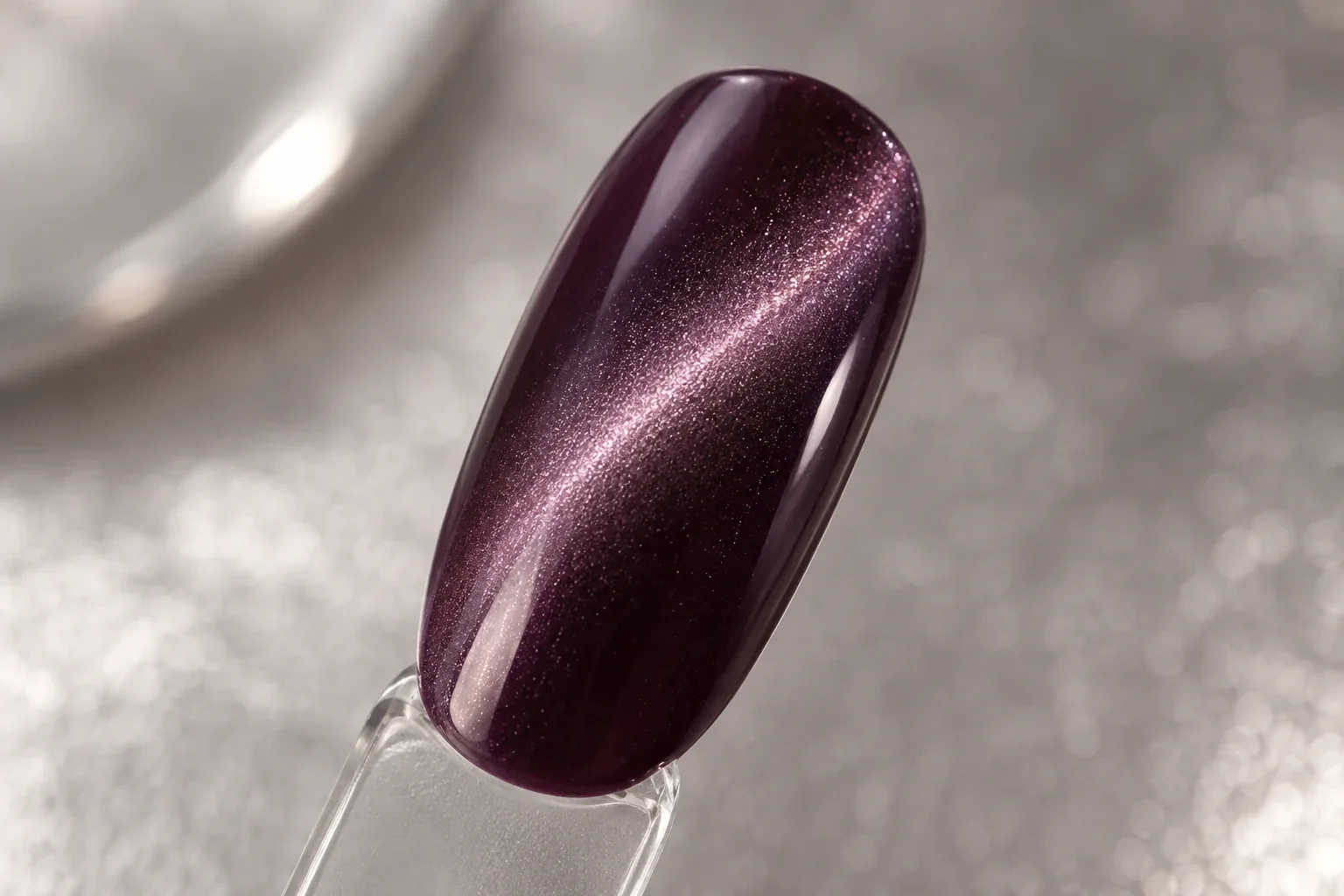
Duochrome and multichrome are terms brands use for polishes whose colour appears to change with the angle of the nail and the type of lighting; “Ultra Chrome” is one brand’s name for its own class. Interference pigments, which build colour from light interacting with thin layers, are a known way to produce angle-dependent colour in other coatings, but none of the product pages consulted states which pigment a given polish uses. The prefixes also do not count colours reliably: one retailer page calls a polish that shifts through five listed colours a duochrome. [1][2][3][4]
KEY TAKEAWAYS
- A colour shift depends on angle and light: ILNP says its Undenied moves through violet, red and gold depending on the angle of the fingertips and the type of lighting. [1]
- Interference pigments are a known mechanism for angle-dependent colour in other coatings, where colour depends on thin-layer thickness and viewing angle, but no page consulted states which pigment a given polish uses, so that link is an editorial inference. [2][3]
- The prefixes are not reliable colour counts: pages call a two-colour polish a duochrome, a blue-to-purple polish with hints of red and gold a duo-chrome, and a five-colour polish a duochrome. [4][5][6]
- A buyer can check opacity, coat count and base-colour wording; the listed shift colours are brand claims whose appearance depends on light and angle. [1][4][6]
What a colour shift is
A colour-shift polish looks different from different positions. ILNP describes its Undenied as shifting through hues of violet, red and gold depending on the angle of the fingertips and the type of lighting, and places it in its Ultra Chrome® class of multichromatic polishes. “Ultra Chrome” is therefore ILNP’s own class name, so this article treats it as a brand label rather than a general category. [1]
Two things change when a hand moves: the direction from which the nail is viewed and the direction from which light arrives. A pigment maker’s data sheet for a different pigment family, VIAVI’s SpectraFlair diffractive flakes, says each flake shows a variety of colours depending on the viewing angle and the angle of incident light. ILNP also identifies the type of lighting as relevant to Undenied’s visible colour shift. [1][7]
The physics behind angle-dependent colour
Interference pigments are a known explanation for this kind of shift in coatings. A coatings-industry primer in PCI Magazine says pearlescent pigments give depth and colour that change with the viewing angle, in contrast to metallic flakes where only lightness changes, and that each interference colour is set by the thickness of the titanium dioxide layer on the mica. OpenStax’s College Physics adds that the thickness of a thin film relative to the wavelength of light is a crucial factor in its colour, and that some car paints use thin film interference to produce colours that change with angle. [2][3]
Linking a duochrome polish to interference pigments is an editorial inference. The pages consulted name colours, coats and ingredients but no mechanism, and the may-contain lists on ILNP’s Undenied and Unfazed pages include mica, titanium dioxide, iron oxides and aluminum powder without saying which ingredients produce the shift. The link is plausible, not demonstrated. [1][6]
What the prefixes do and do not count
None of the pages consulted defines duochrome and multichrome by the number of colours, so any rule of thumb has to come from usage. Cupcake Polish lists Heart of Iceland as a duochrome polish moving between a light red and a golden orange. ILNP describes Unfazed as a duo-chrome base that flips from blue to purple, with hints of red and gold in certain lighting. A retailer’s page for KBShimmer’s Worth A Shot calls it a duochrome nail polish that shifts from faded grape purple to peach, gold, lime and aqua. [4][5][6]
On this evidence “duo” is used for two colours, for two main colours with extras, and for five, so the prefix reads more as a brand style label than as a count. The name tells you the polish shifts, not how many colours to expect; this is an editorial reading of three pages, not a survey of all brands. [4][5][6]
Product-page wording and what to check
The table sets common wording from the pages consulted against what a buyer can check. The examples are attributed seller descriptions, not observations of the polishes.
| Wording | Examples from the pages | What to check |
|---|---|---|
| Colours named [1][4][5] | Undenied: violet, red and gold. Heart of Iceland: light red to golden orange. Worth A Shot: faded grape purple, peach, gold, lime and aqua. | Which colours appear on your own nail in your own light. |
| Dependence on angle and light [1] | Undenied: the shift depends on fingertip angle and the type of lighting. | The page gives no angles or light spectrum, so look for swatch photos taken under more than one light. |
| Coats and opacity [1][4][6] | Undenied: described as fully opaque after two coats, with the Opacity field set to Buildable. Unfazed: recommended 2-3 coats. Worth A Shot: builds to full opacity in two to three coats. | Opacity can be checked with a swatch, but it depends on application and base. |
| Base colour [1][4] | Undenied: formulated to apply directly to the nail without a base colour. Worth A Shot: multichrome shimmer layered over a medium purple base. | How a different underlying colour would change the shift. |
| Other effects [6] | Unfazed: a duo-chrome base plus holographic micro-flakes, with Effect listed as Holographic and Holo Finish as Scattered. | A product can combine effects, so the headline word may describe only part of the look. |
Reading a shift claim before you buy
Treat the listed colours as attributed claims that depend on viewing conditions, not as measured properties. A buyer can compare concrete details instead: whether the page gives a coat count or opacity, whether it needs a base colour and whether it mentions other effects such as holographic flakes. A photograph is a further caution, because a shift photographed under one light and angle shows only part of the range. [1][4][6]
A hypothetical example: a studio photographs a duochrome swatch under a ring light at one angle for its price list, while the manufacturer’s image shows the same polish in daylight at another angle. The two photographs may show different colours without either being wrong, so the studio would do better to describe the shift in words and show two angles. This illustrates the point and is not a measured comparison.
This article is also available in NailWiki’s English reference library. Both sites are published by BELOM Group OÜ.
Article Sources
- ILNP - Undenied - Violet to Gold Ultra Chrome Nail Polish
Commercial source material
Product page “Undenied - Violet to Gold Ultra Chrome Nail Polish”: description of the shift (violet, red and gold; angle of the fingertips; type of lighting), the Ultra Chrome® class sentence, the statement that it applies directly to the nail without a base colour, the line on full opacity after two coats, the product fields (Color, Effect, Opacity; no Finish field) and the May contain ingredients group.
- PCI Magazine (authors from Sun Chemical) - Pearlescent Pigments in Coatings – a Primer
Expert reference material
Article “Pearlescent Pigments in Coatings – a Primer” (Sun Chemical authors; 1 August 2018): passages on interference colour set by titanium dioxide thickness, complementary colour at diffuse angles, and depth and colour change compared with metallic flakes. Coatings context.
Source date:
- OpenStax, College Physics 2e (Rice University) - 27.7 Thin Film Interference
Expert reference material
Textbook section “27.7 Thin Film Interference” in College Physics 2e: film thickness relative to wavelength, and the sentence on car paints that use thin film interference to produce colours that change with angle.
- Beyond Polish (retailer) - KBShimmer - Nail Polish - Worth A Shot
Commercial source material
Retailer product page “KBShimmer - Nail Polish - Worth A Shot”: opening description (duochrome nail polish shifting from faded grape purple to peach, gold, lime and aqua), the statement that it layers multichrome shimmer over a medium purple base, and the two-to-three coat opacity sentence. Product type Nail Lacquer; the copy is not attributed to the brand or the retailer.
- Cupcake Polish - Heart of Iceland
Commercial source material
Product page “Heart of Iceland”: description sentence calling it a duochrome polish that shifts from a light red to a golden orange; Finish field and coats listed as 2-3.
- ILNP - Unfazed - Blue to Purple Duochrome Holographic Nail Polish
Commercial source material
Product page “Unfazed” (subtitle “Blue to Purple Duochrome Holographic Nail Polish”): description sentences on the duo-chrome base and the holographic micro-flakes, the line Recommended: 2-3 Coats, the product fields Effect, Holo Finish and Opacity, and the May contain group.
- VIAVI Solutions - SpectraFlair Light Diffractive Pigments (Data Sheet)
Commercial source material
Data sheet “SpectraFlair Light Diffractive Pigments”, page 1 introduction: each flake shows a variety of colours depending on the viewing angle and the angle of incident light. Printed © 2023 VIAVI Solutions Inc.; multilayer flakes for paints, coatings, plastics, textiles and packaging, not a nail product.
Based on the linked sources. No hands-on product testing or independent specialist review was performed.
Commercial resource from our ecosystem
These links lead to commercial projects in our ecosystem. They are kept separate from the explanation above and are not evidence for any statement in this article.
Our shop’s gel polish and colour category, whose finish filter lists effects such as Flash effect, Holo effect and Cat Eye but not duochrome or multichrome; nothing here implies availability of colour-shift products, stock or performance. NailMarket gel polish and nail colours
Brand resource only; no technical, launch, testing or certification claim. BELOM equipment project
BELOM and NailMarket are commercial projects in our ecosystem.