Flash-reflective glitter: how a nail can flare in a camera flash
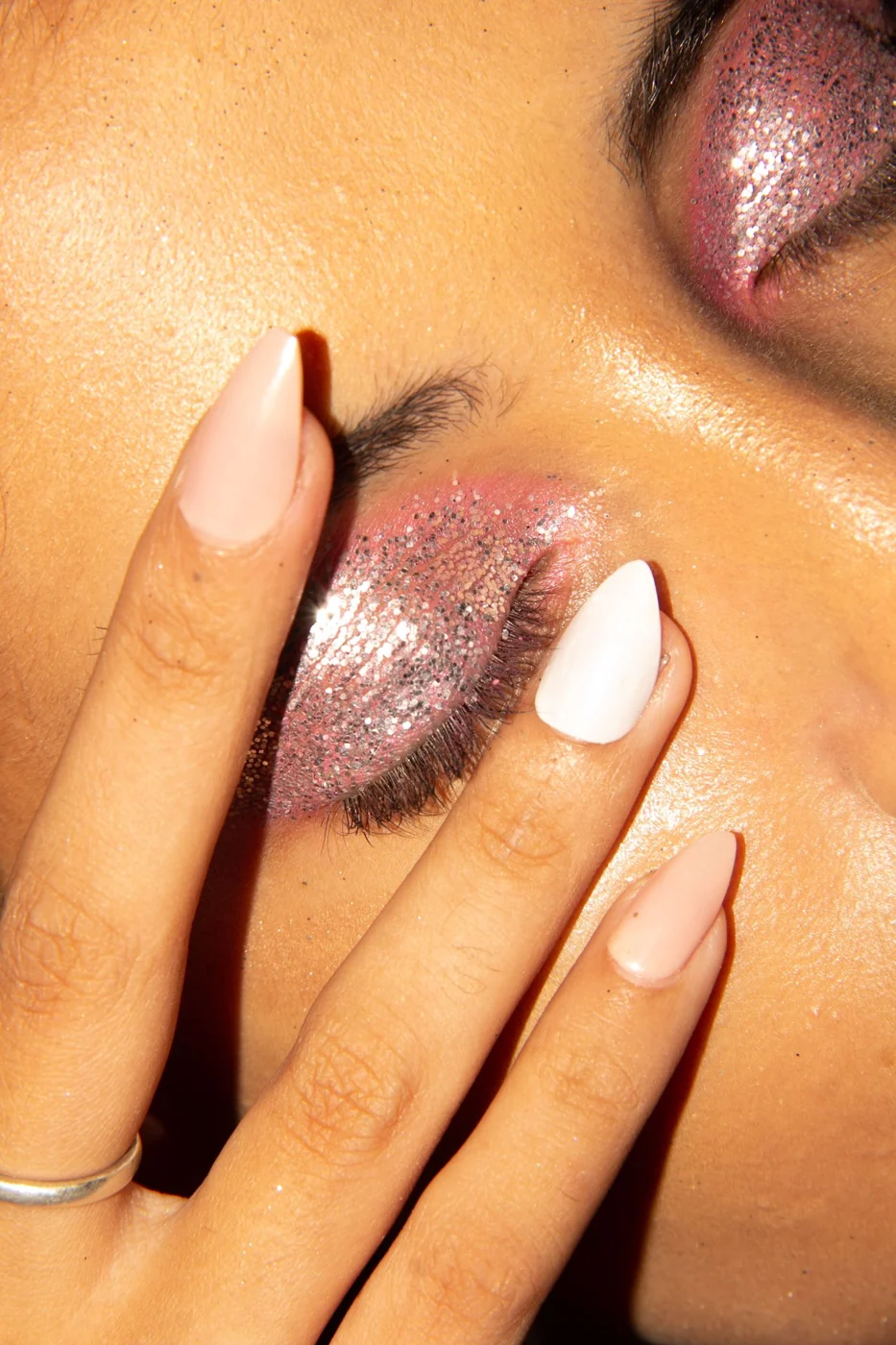
“Flash-reflective” or “flash-reactive” glitter is a seller’s label for glitter said to flare in direct light or a camera flash. One optical idea that fits such claims is retroreflection, where light returns along a path parallel to the one it came from instead of bouncing away like a mirror reflection. None of the three seller pages opened shows that any nail polish uses retroreflective particles, though: Cirque Colors says its particles “bounce back direct light” without naming a structure, the other sellers describe glass spheres or holographic glitter, and none gives a measurement. Retroreflection therefore stays an optical concept, not a verified fact about any polish. [1][2][3][4]
KEY TAKEAWAYS
- A flat mirror follows the equal-angle law of reflection; it does not generally send light back to its source. Retroreflection redirects light back towards the source over a range of incoming directions. [2]
- Cirque Colors says its flash-reactive glitter bounces back direct light such as sunlight or strong indoor bulbs; its description does not mention a camera flash or name a particle structure. [1]
- Three sellers give three accounts of their particles, namely special glitter particles, glass spheres and holographic glitter, and none of the pages shows a measurement. [1][3][4]
- A bright flash photograph cannot by itself show whether particles are retroreflective, because mirror-like flakes that happen to face the camera could also return a flash; that point is our inference.
Ordinary sparkle and retroreflection are different things
Ordinary glitter sparkles by mirror-like reflection. An engineering explainer in the University of Southern California’s Illumin magazine contrasts retroreflection with the equal-angle law for a flat reflecting surface. A flat surface returns a ray towards its source only at the appropriate alignment. A flat flake therefore sends a glint to the eye only when it faces the right way, which is why ordinary sparkle twinkles as the hand or head moves; that application to glitter is our reasoning, not Illumin’s. [2]
Retroreflection returns light along a path parallel to the one it arrived on, toward the source. Illumin describes two designs used in road markings and signs. In road paint, light bends into a glass bead and reflects from the paint–glass boundary behind it. It then leaves parallel to the incoming beam. In beaded sign sheeting, the backing sheet provides the reflecting boundary instead of paint. A second design uses microprisms, or corner-cube prisms, moulded into sheeting. Illumin describes these as relying on regular reflections. Its article concerns road safety, not cosmetics or cameras. [2]
If a flash is close to the camera lens, light directed back towards the flash can also enter the lens. That conditional geometric example links retroreflection with flash photography; it does not establish the construction of a nail-polish particle.
What three sellers say their flash glitter does
Sellers describe flash-triggered effects in different ways, and none of the pages opened gives a measurement or an independent test. The table sets out the wording of three pages. [1][3][4]
| Seller page | What it says the particles are | What it says about direct light or flash | What the wording leaves open |
|---|---|---|---|
| Cirque Colors, Enigma (red flash reflective glitter polish) [1] | “special glitter particles” in a clear base | They “bounce back direct light (such as sunlight or strong indoor bulbs)”; camera flash is not mentioned in the description | No structure is named and the term retroreflection is not used. |
| ND Nails Supply, blog on reflective nail polish [3] | Ultra-tiny glass spheres working with the resin | “any bright illumination like a camera flash makes reflective polish practically glow” | A seller’s blog (by Tran Khue, 20 October 2023), not a test of any product. |
| Wildflowers Nail Shop, Gel Polish - Sparks [4] | “holographic glitter gels” | “a wild flare when you use your camera flash”, with a direction to use the phone’s flash to capture the flare | The page gives no reason for the flare. |
What a flash flare can and cannot show
The retroreflection concept shows how a flash-triggered flare could arise, but none of the three seller pages shows that a nail polish uses retroreflective beads or prisms. Cirque Colors’ wording does not use the term or name a structure, ND Nails Supply’s glass-sphere description is consistent with a bead retroreflector but is a seller’s account, and Wildflowers describes holographic glitter. [1][2][3][4]
A bright flash flare also cannot separate the possibilities by itself. Flat, mirror-like flakes that happen to face the camera would also return a flash, so a photograph taken with flash is consistent with ordinary glitter as well as with retroreflective particles. This is our inference, and no source opened tests it.
A hypothetical example: a studio plans portfolio photographs of nails with a flash-reactive glitter. Under soft window light the glitter might look calmer, while a phone flash might produce a brighter flare. The studio could photograph both ways and describe each honestly instead of promising the flare in every light.
This article is also available in NailWiki’s English reference library. Both sites are published by BELOM Group OÜ.
Article Sources
- Cirque Colors - Red Flash Reflective Nail Polish - Cirque Colors Enigma
Commercial source material
Product page “Red Flash Reflective Nail Polish - Cirque Colors Enigma”: the two description sentences that introduce a red flash reactive glitter polish in a clear base and say its special glitter particles bounce back direct light, with a parenthetical naming sunlight and strong indoor bulbs. The title says reflective and the description says reactive; the description does not mention camera flash, a particle structure or the term retroreflection.
- Illumin, University of Southern California - Stay In Your Lane: The Optical Phenomenon Of Retroreflection
Expert reference material
Article “Stay In Your Lane: The Optical Phenomenon Of Retroreflection” (Helen Situ, an undergraduate engineering student; 14 February 2022), sections “What is Retroreflection?”, “Glass Beads as Retroreflectors” and “Microprisms as Retroreflectors”: definition of retroreflection, the regular-reflection statement, the bead mechanism (road paint and sign sheeting), the corner-cube description (sheeting). Road-marking context; no mention of cameras or cosmetics.
Source date:
- ND Nails Supply - The Best Reflective Nail Polish for a Dazzling Manicure
Commercial source material
Blog article “The Best Reflective Nail Polish for a Dazzling Manicure” (ND Nails Supply; byline Tran Khue, 20 October 2023), sections “What Makes Reflective Polish Different from Glitter Polish?” and “What's the Magic Behind Reflective Polish?”: the glass-sphere sentences and the camera-flash sentence. The article body appears after about 100,000 characters of page navigation.
Source date:
- Wildflowers Nail Shop - Gel Polish - Sparks
Commercial source material
Product page “Gel Polish - Sparks”: the description sentence on holographic glitter gels and a flare under a camera flash, and the Directions sentence advising use of the phone’s flash to capture the flare.
Based on the linked sources. No hands-on product testing or independent specialist review was performed.
Commercial resource from our ecosystem
These links lead to commercial projects in our ecosystem. They are kept separate from the explanation above and are not evidence for any statement in this article.
A category page titled Holy Molly Flash gel polish colours that lists numbered Holy Molly FLASH shades in 11 ml bottles. The page names no optical mechanism, retroreflection or camera-flash behaviour, and no stock or performance is implied. NailMarket flash gel polish colours
Brand resource only; no technical, launch, testing or certification claim. BELOM equipment project
BELOM and NailMarket are commercial projects in our ecosystem.